

Like Our Parents
If Lula no longer wins the youth vote, who represents the new Brazil?


Como Nossos Pais (Like Our Parents) – Brazil 1976
This year will be the 50th anniversary of one of Brazil’s defining pop cultural moments, Elis Regina’s performance of Como Nossos Pais (Like Our Parents) on TV Globo in 1976.
In front of a prime-time Brazilian audience, Elis Regina transformed a melancholic and reflective song into both a rallying cry for Brazil’s youth and an invective against its older generations.
She deliberately emphasised words and phrases about young people and a new youth consciousness, then glared into the camera as she sang, “it’s you who loves the past and doesn’t see that the new always arrives.” At the song’s crescendo, she delivered the final line of the chorus – “como nossos pais” (“like our parents”) – and pointed behind her to a row of shabby stuffed dolls dressed in old-fashioned finery.
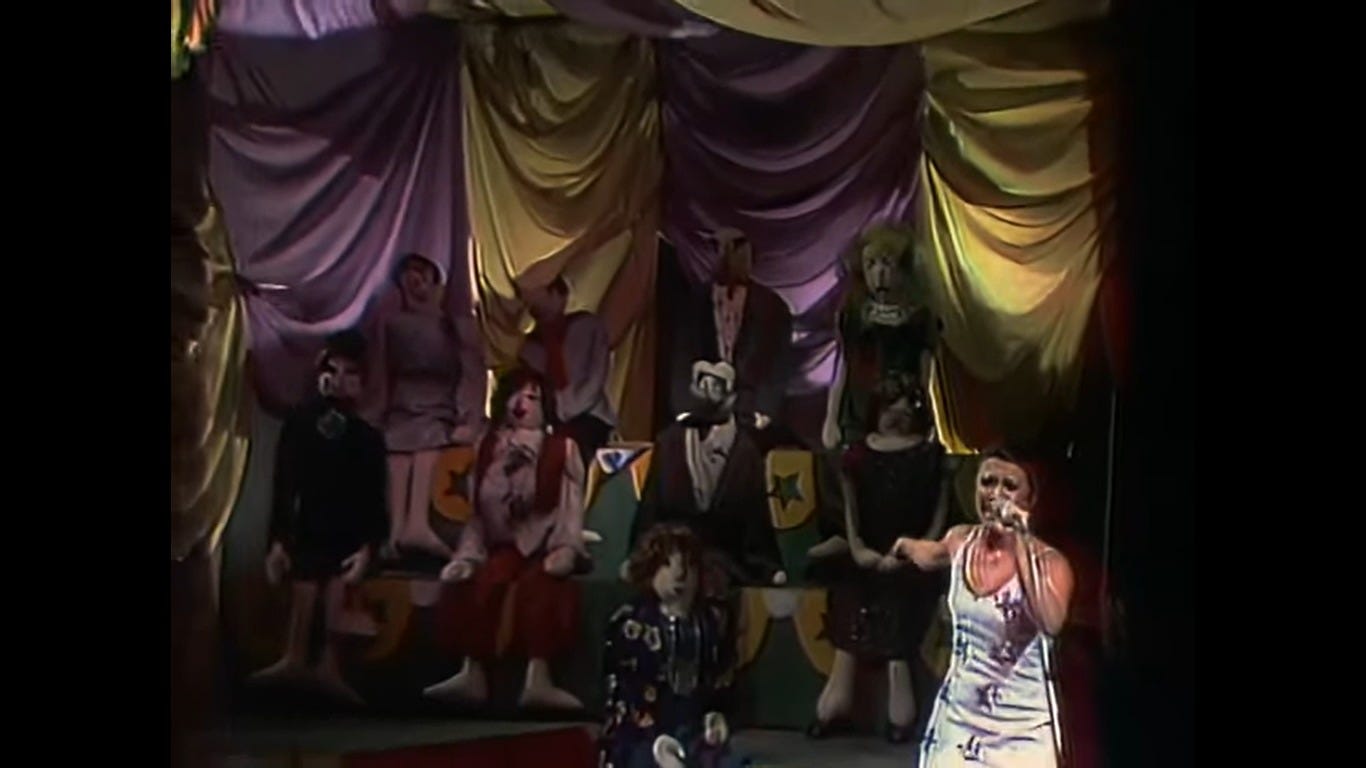
In the original song, Belchior’s narrator is constantly negating and doubting themselves, and the tone suggests a fear of being trapped in a cycle of youthful promise and eventual disillusionment. But Elis Regina’s interpretation seemed to cry out a different, more elemental message: of change as a natural process, like the seasons and the weather, one that can’t be stopped or reversed.
She also turned this message into a challenge for the establishment; that the new always arrives, and that the young – though temporarily without power – were fully aware of their parent’s complicity with the then-current regime.
1976 – the year of her performance – would turn out to be the beginning of a larger change in Brazil. Geisel’s presidency replaced the extremely repressive Medici regime that ended in 1974, and this new period would eventually lead to the amnesty law of 1980, paving the way to re-democratisation in 1985.
In spite of its lyrics that question this very ideal, Regina’s performance – her radiant fervour flanked by those grey puppets – is one of the most potent encapsulations of how intertwined with youth the re-democratisation movement in Brazil was at the time, and how it is still remembered today: an old order crumbling, septuagenarian white haired men weighed down by their self-appointed medals, swept away by an irrepressible generation of hope, smiles, colour, music, democracy and freedom.
That was fifty years ago. But ever since, the connection between youth and progressive politics has been kept in a state of suspended animation, a kind of endless tribute act to the generation who helped establish this still young democracy. Now, two generations later, the same song that once signalled the inevitable end of the dictatorship, points towards an uncomfortable moment for the Brazilian left.
Como Nossos Pais (Like Our Parents) – Lula 2026
It’s 2026 and Lula, the figurehead of Brazilian progressive politics, is eighty years old. Perhaps more perplexingly still, after forty years at the forefront of the Brazilian left, both he and his movement have yet to find a definite heir. Instead, he is running for a fourth presidential term. Sixteen year olds who voted for Lula when he first ran in 1989 will turn 53 this year. People who were born when he first took office are 23 years old, almost too old to be included in the youngest demographic pollsters usually survey: 18-24.
And it’s specifically this age group that should cause him, and his supporters, concern. While not conclusive by any means, recent surveys have shown that not only do three out of four 18-24 year olds disapprove of the Lula government – more than any other demographic group – but even in a December poll where Lula beats his right-wing rival Flavio Bolsonaro convincingly, 18-24 year olds were the only demographic to favour Flavio.
It’s worth mentioning that recent presidential candidates from Lula’s hegemonic left-wing party PT have not exactly dominated the youth vote. But it’s still unusual that one could be relatively popular with other age groups while trailing against a less popular candidate specifically among the youngest voters – and even more confounding given that Lula won the youth vote comprehensively in 2022, by as much as 53% to Jair Bolsonaro’s 39% in the second round.
Como Nossos Pais (Like Our Parents) – Lula 2022
When Bolsonaro won in 2018, Como Nossos Pais emerged once again, this time as an unofficial anthem of resignation for many who still believed in the youthful promise of the eighties re-democratisation movement, and who despaired that Bolsonaro was voted in by people who wanted to push Brazil even further back to its pre-democratic state.
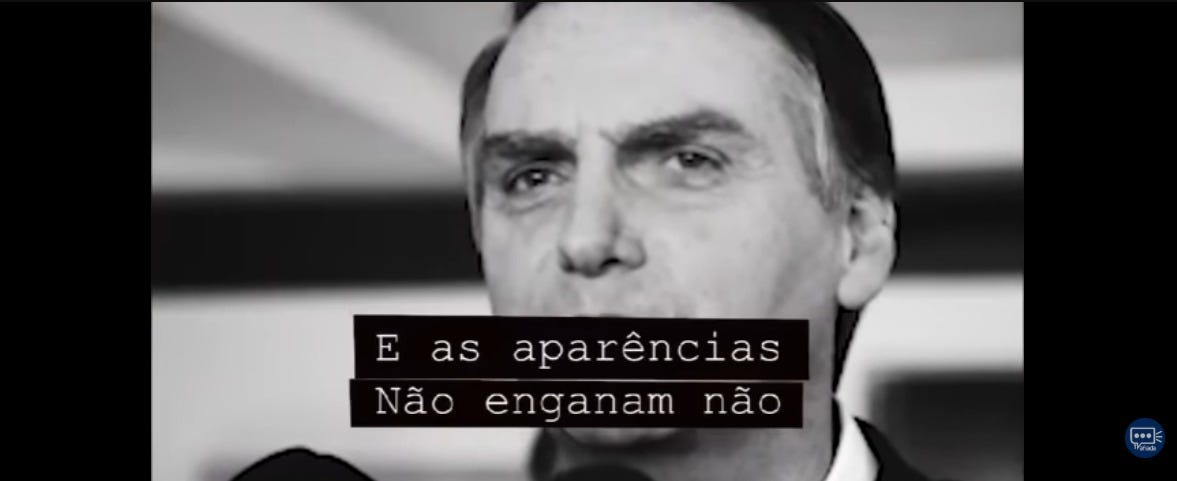
I believe that one reason Lula performed so well with young people in 2022 is that he got to revive his rebellious, anti-dictatorship image, and many young people finally had a chance to act like their parents and, by voting for Lula, feel like they were voting away an age of conservatism and repression in Brazil, just as their parents talked about doing in 1989.
2022 also reestablished a well-known pattern for Lula, his ability to campaign as a radical and then govern as a pragmatist. In the first two terms of his presidency, from 2003-2010, the raised fists and protest anthems seemed to all but vanish as Lula enjoyed a long stint in power. But as Dilma got threatened with impeachment and Lula with jail, the old political rebel image was brought back.
While Lula was in prison, a popular image was of his Che Guevara style mugshot from his arrest by the military dictatorship in 1980, at 35-years old. And while those on the right celebrated his sentence as that of a corrupt criminal mastermind brought to justice, those on the left cultivated an image of him as a political prisoner, just like many who suffered under the twenty-year regime.
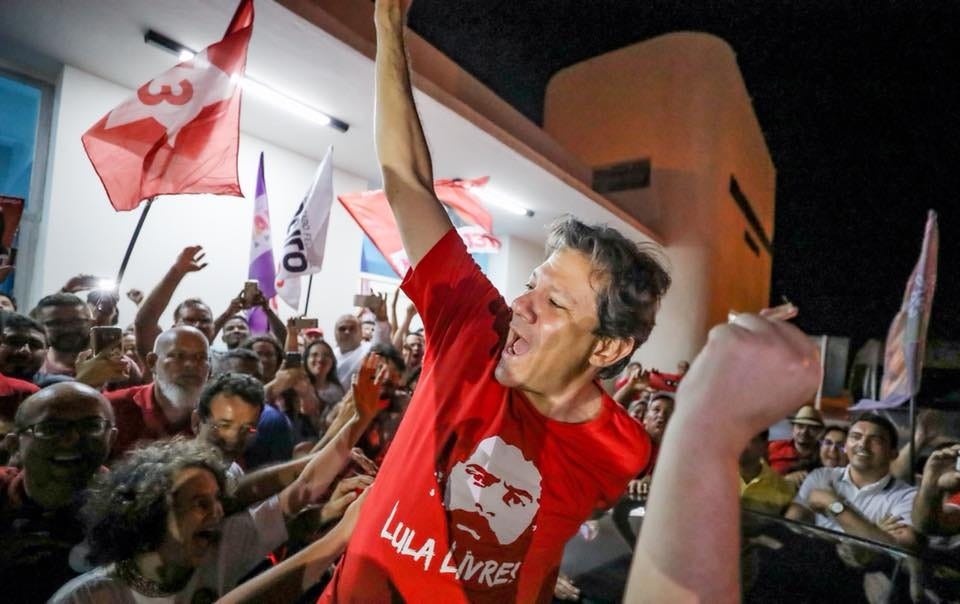
This re-branding benefitted from Jair Bolsonaro also playing his part well, putting some spluttering tanks on the Planalto, throwing doubt on Brazil’s electronic voting system, and having a concept of a plan of overthrowing the democratically elected government.
Lula won, just, by 51% to 49%, but he did so with the resounding support of the youngest Brazilians.
Como Nossos Pais (Like Our Parents) – Flavio 2026
The fitting irony is that Flavio Bolsonaro is, of course, running as a surrogate for his imprisoned father. He is literally like his parents. And he’s relying on the glow of his father’s retrograde opinions and values to win him support among right-wing voters, especially those that are nostalgic for the dictatorship, even the monarchy, of which there are many.
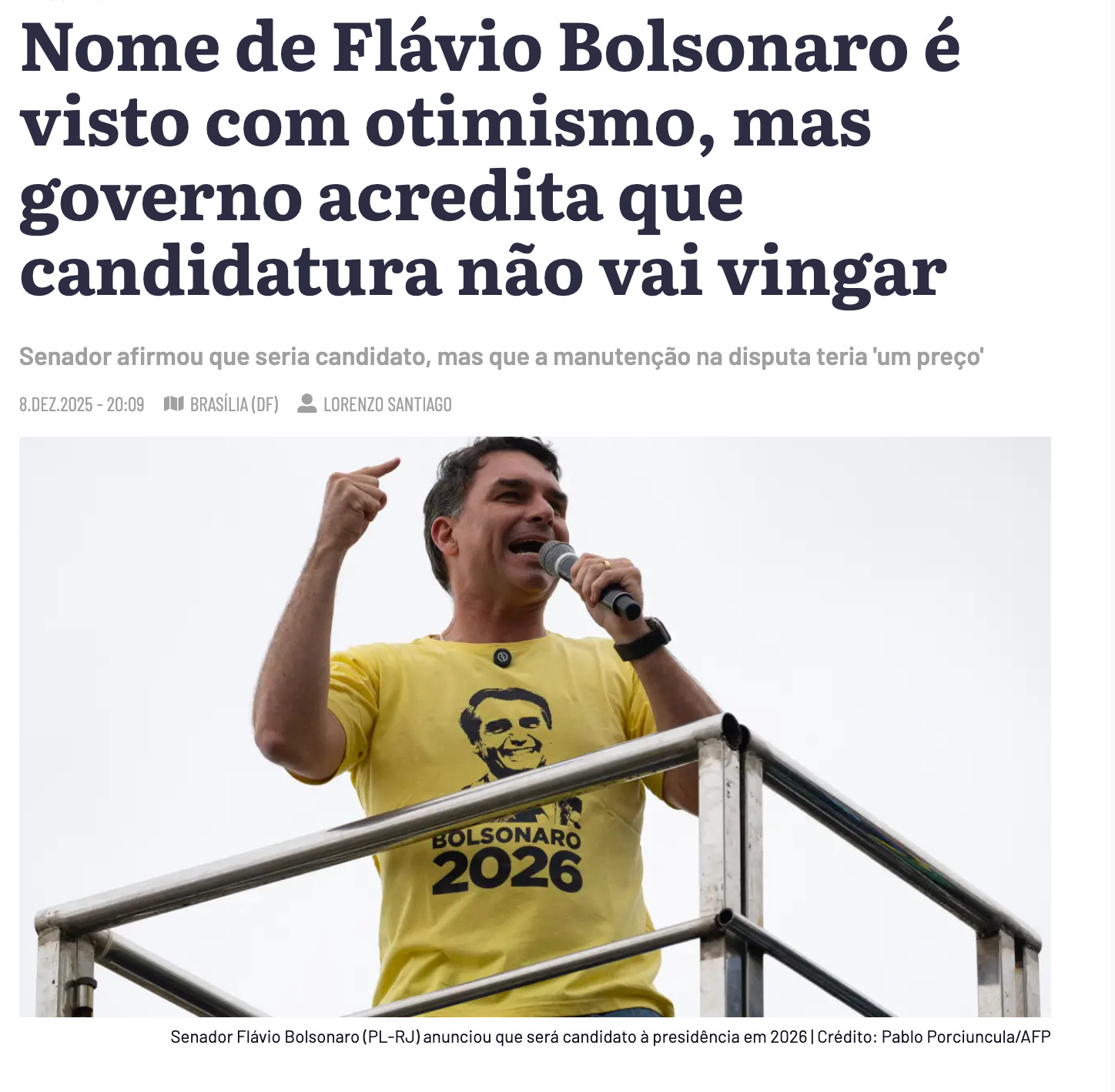
But this inheritance doesn’t seem to explain the shift in youth support. Remember Lula v Jair in 2022.
Looking at recent political successes in Latin America, we can see that younger people are more than willing to vote for a right-wing or at least anti-left wing candidate. Milei and Bukele – two role models that Flavio is often seeking to compare himself to – both did extremely well with younger voters. These pioneers of the new right also don’t appeal to traditional conservative values of continuity but to disruption. Bukele and Milei are both inspired by start ups, crypto, and the move fast, break stuff mentality of Silicon Valley.
Flavio seems to, at least on an instinctive level, have understood this.
In a recent interview, he called Lula an Opala Velho (an iconic vintage Brazilian car). Weirdly, his insult sounded a lot like a compliment, “At some point the Opala was once beautiful, it was once a luxury car, which gave results and took you anywhere. Today, Lula is a retrograde, backward and outdated person.”

But I think this is where Flavio may gain a potent narrative: He’s not saying Lula is bad. He’s saying he belongs to the past.
Flavio’s appeal to a lot of young Brazilians could be of a different future, one that has already been gaining a significant amount of support among all cross-sections of society.
This is a future that Jair Bolsonaro half groped towards but didn’t really grasp, and one that Flavio is in much more of a position to set as his north star for the rest of the election campaign. It’s more than just a new slogan; it accurately reflects a complex generational change in how young Brazilians now imagine success.
Lula told young people that the path to success was through education. He established a quota system guaranteeing university places to black, indigenous, and low-income Brazilians. He told them to put their faith in credentialed, state-backed social mobility – even if, at the same time, a shadier industry of private universities popped up, a side-effect that Lula’s government largely ignored.
Flavio can tell young people that the path to success is through entrepreneurship. And with a growing number of unemployed graduates, a shrinking number of public sector roles and an explosion in micro-entrepreneurship, more young people now agree with him than with Lula.
Plenty of recent studies show how many young Brazilians, especially among the poorest, now say they’d rather “be their own boss” than work for anyone else.
This is a future that Lula and Dilma’s governments created the conditions for, even as they tried to keep the narrative of state-supported progress alive.
Millions of young Brazilians are investing in crypto, signing up for online courses with influencers, betting on apps, praying to a god that promises prosperity. Recent corporate success stories of Brazil – Nubank, Loggi, iFood – are based on disruptive leapfrogs over once bureaucratically dense business processes – banking, logistics, deliveries.
Maybe these young people think that if they haven’t struck big just yet, it could be because the Opala Velho is slowing them down. With a DOGE-style government powered by AI, they imagine, there’d be less vague distributionism and more of a chance for them to take the reins and end up ahead.
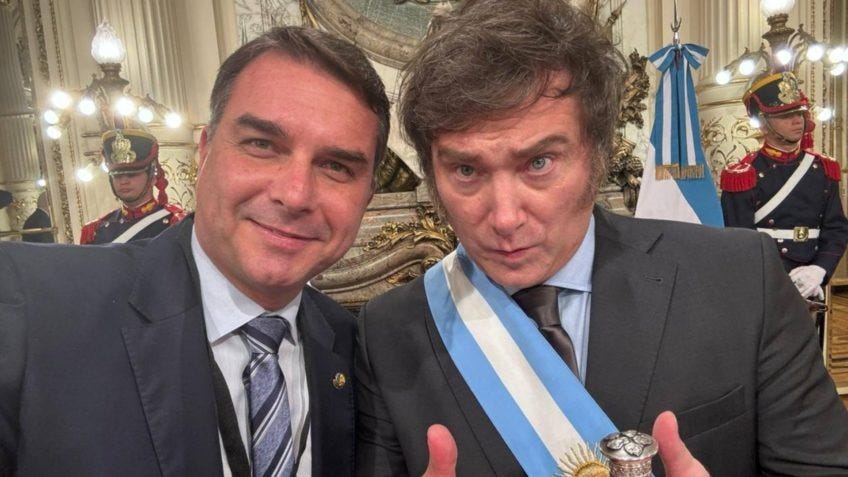
Perhaps Flavio won’t need to explicitly embody such a prospect. Simply promising to remove Lula from Brazil’s future might be enough.
Still, that is far from the whole story. The youngest generation are as anxious as they are ambitious. There’s also plenty of research showing how Gen Z Brazilians (and everywhere) are increasingly nostalgic for screen-free pasts and looking to unplug rather than accelerate. And who is a better model for living in the moment than eighty year old Lula in a sunga, with not a cell phone in sight?
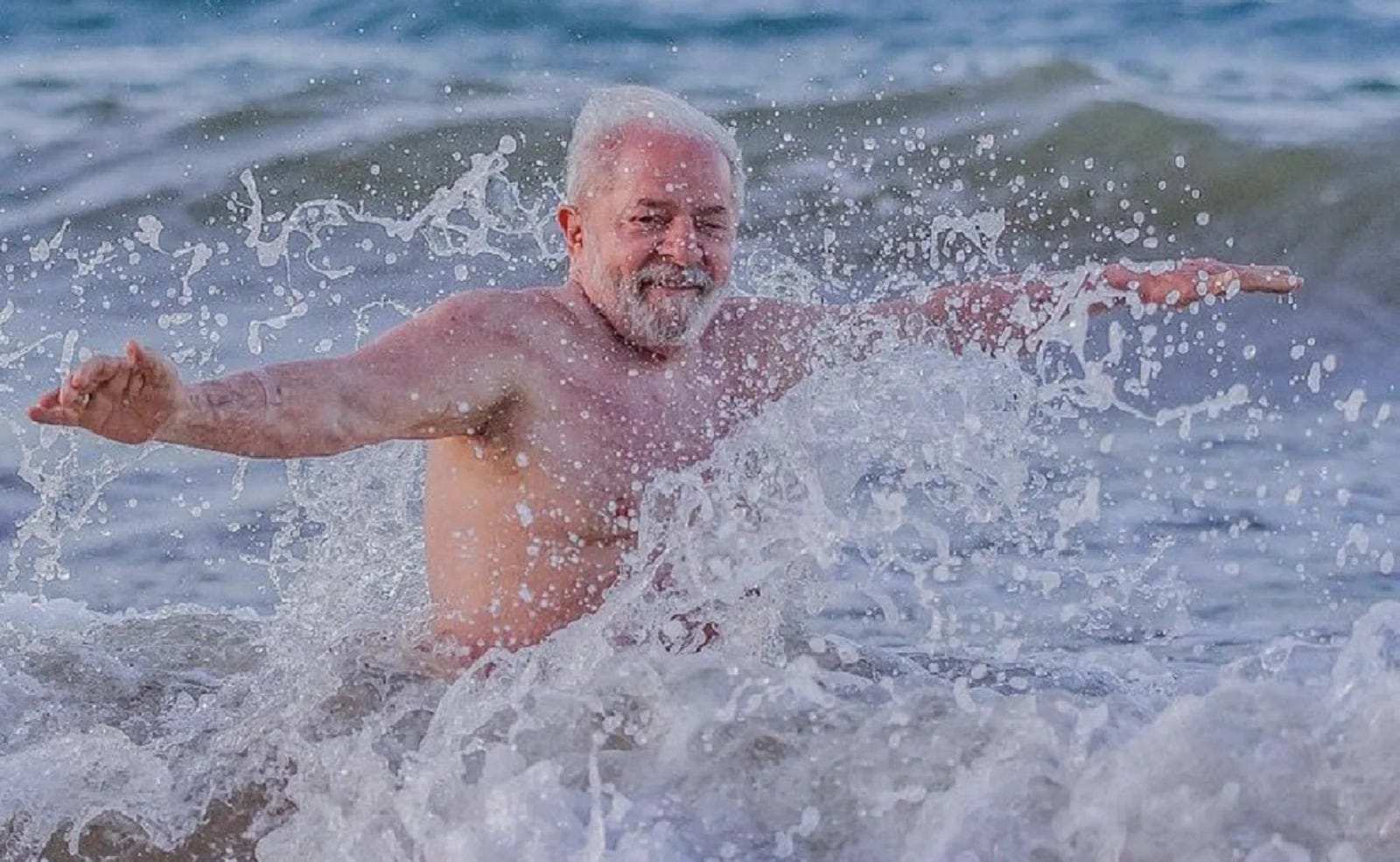
After all, crypto, bets and multi-level marketing produce a lot more losers than winners. Lula 3.0 has economically outperformed many forecasters’ expectations – not supercharging growth but providing some stability in a chaotic world. The AI bubble could deflate and Lula all of a sudden looks the wise old sage, the sturdy vintage car that can motor on when ‘everything’s computer’ runs out of juice. He could do one more retro campaign for the left and, instead of readopting his prison mugshot, conjure up 2016’s Corbyn and Sanders (rather than 2024’s Biden).
Whatever happens, something has been changing with the young of Brazil. Flavio is his father’s son, but his narrative strength may be in fashioning himself as the inevitable arrival of a new, disruptive generation. At the same time, Lula might be eighty, but if anyone can reinvent that into an electable trait, it’s him. Fifty years ago, Belchior sung that the new always arrives. This year, we still don’t know what it will arrive as.